
The most spectacular morning view in the Highlands isn’t found through a hotel window. It is framed by the back doors of your van, looking out over a glass-calm sea loch as the mist lifts. Finding those perfect wild camping spots West Coast Scotland campervan explorers crave feels like uncovering a secret, yet many travellers hesitate. You might worry about the dreaded 2 AM knock on the window or feel overwhelmed by the narrow, winding ribbons of single-track roads that define the Atlantic coast.
We understand that the line between a dream adventure and a stressful night can be thin. It is entirely possible to wake up to absolute silence and a sunrise that stays with you forever, provided you know the rules of the road. This guide is your definitive 2026 roadmap to exploring the West Coast responsibly and comfortably. We will clarify the confusing overlap between the Land Reform Act and the Road Traffic Act, ensuring you stay legal whilst enjoying the true spirit of the Highlands. From identifying reliable regions to perfecting your packing list with essential gear like fire pits and paddleboards, you will gain the confidence to turn the rugged Scottish wilderness into your personal mobile basecamp.
Key Takeaways
- Learn the crucial distinction between wild camping and informal overnight parking to ensure you stay within the law whilst exploring the coast.
- Master the “Late In, Early Out” etiquette and modern waste management practices to keep the Highland landscape pristine for everyone.
- Discover the best regions for finding reliable wild camping spots West Coast Scotland campervan enthusiasts love, from rugged Wester Ross to the isolated Ardnamurchan Peninsula.
- Get practical advice on navigating the unique challenges of the coast, including midge management and booking CalMac ferries for island hopping.
- Find out how to kit out your mobile basecamp with adventure gear like paddleboards and fire pits to make every wild stay feel like home.
Wild Camping vs Informal Parking: What You Need to Know
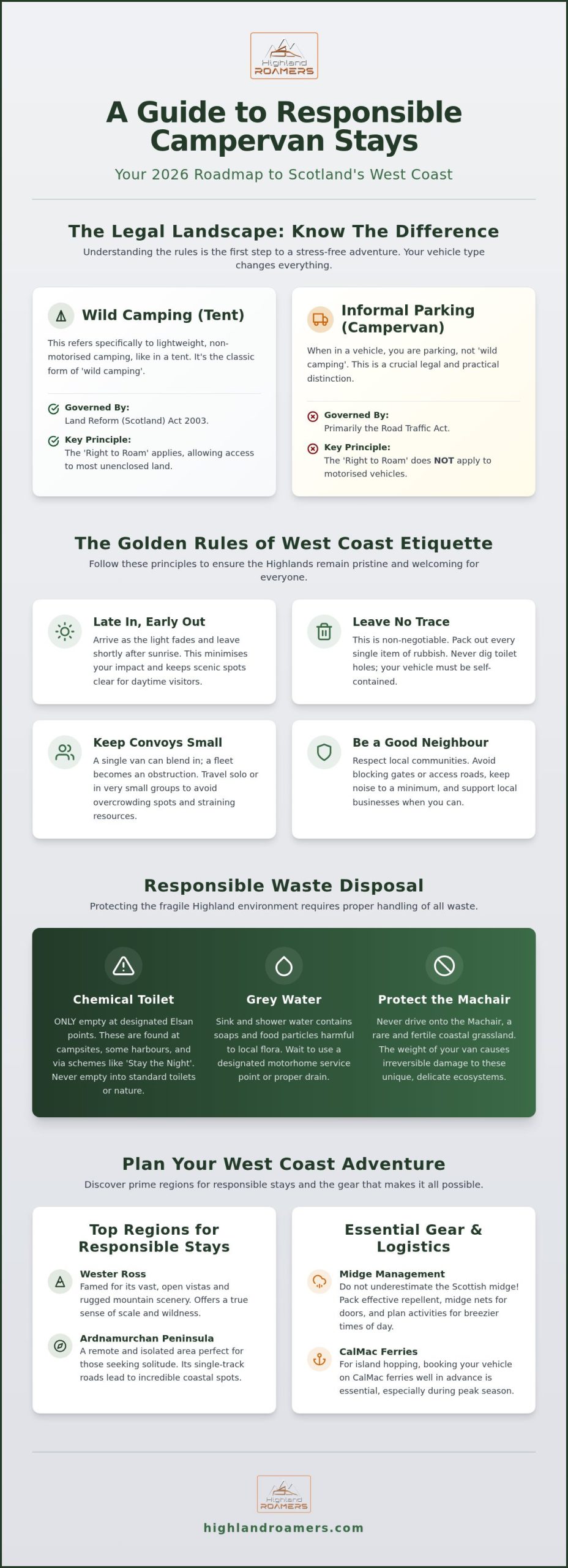
Adventure starts with a clear map, but understanding the legal landscape is just as vital as knowing your route. Many travellers search for wild camping spots West Coast Scotland campervan enthusiasts rave about, but there is a linguistic trap to avoid. Technically, wild camping in Scotland refers specifically to lightweight, tent-based stays. When you are in a vehicle, you are actually engaging in informal overnight parking. This distinction matters because the Land Reform (Scotland) Act 2003, which grants the right to roam, does not apply to motorised vehicles.
The West Coast has become the spiritual heart of the Scottish van-life movement. Its vast, open vistas and sense of isolation offer a freedom found nowhere else in the UK. However, your van does not have a right to roam in the same way your boots do. Motorised vehicles are governed primarily by the Road Traffic Act, meaning the rules for where you can pull over differ significantly from those for a hiker with a bivvy bag. Understanding this helps you explore with confidence and avoid the stress of an unexpected move-on.
Is Wild Camping in a Van Legal in Scotland?
Parking on public road verges or in laybys occupies a complex legal grey area. In Scotland, trespassing is generally a civil matter rather than a criminal one, provided you aren’t causing a nuisance, blocking access, or damaging property. Under the 1988 Road Traffic Act, you may drive a motor vehicle onto land within 15 yards of a public road for the purpose of parking, but this does not provide a legal right to stay overnight. Local bylaws, particularly in areas like the Loch Lomond and The Trossachs National Park, can override these general rules. Always check for local signage that might prohibit overnight stays to ensure your adventure remains on the right side of the law.
The ‘Right to Roam’ and Your Responsibilities
Even though the Scottish Outdoor Access Code technically excludes motor vehicles, its core values are essential for every van explorer. The “Leave No Trace” philosophy is a non-negotiable requirement for anyone using a campervan as a mobile basecamp. This means taking every scrap of litter with you and ensuring your presence leaves no physical mark on the environment.
When searching for wild camping spots West Coast Scotland campervan travellers can use, look for unenclosed land. This typically refers to land that is not fenced off, gated, or used for crops and gardens. Identifying these spots requires a keen eye and a deep respect for the working landscape. If you encounter a gate, leave it as you found it. If a spot looks fragile or overcrowded, move on to the next location. Protecting these spaces ensures the West Coast remains a wild sanctuary for years to come.
The Golden Rules of West Coast Etiquette
Respecting the land is the price of admission for the freedom of the road. Whilst the West Coast offers unparalleled beauty, it is a living, working landscape. When scouting for the best wild camping spots West Coast Scotland campervan explorers can find, remember the ‘Late In, Early Out’ rule. This means arriving at your chosen spot as the light fades and departing shortly after sunrise. This practice ensures that popular viewpoints remain accessible to daytime visitors and prevents any single location from feeling occupied or cluttered.
Waste management has changed. The old hiker’s advice of digging a hole is strictly off-limits for van users. The sheer volume of waste generated by modern tourism means our ecosystems cannot process it. Always carry a dedicated waste system and never, under any circumstances, leave behind anything but your tyre tracks. Large groups also have a heavy impact. Keep your convoy small; a single van is a guest, but a fleet of five is an obstacle.
Environmental Impact and Sustainability
Protecting the fragile Highland environment requires specific logistics and a bit of planning.
- Chemical Disposal: Only empty your toilet at designated Elsan points. These are often found at campsites, harbours, or through the Stay the Night scheme, which provides legal overnight options in forest car parks.
- Grey Water: Your sink and shower water contains soaps that can harm local flora. Wait until you find a proper disposal grid rather than dumping on the verge.
- Machair Protection: The West Coast is famous for its machair, a rare and fertile coastal grassland. Never drive onto these areas. The weight of a van can cause permanent damage to the delicate root systems.
Being a Good Neighbour in Remote Areas
Your presence should be a benefit, not a burden. Avoid parking directly in front of residential windows or blocking farm gates. A blocked gate can stop a crofter’s entire working day. If you meet a local landowner, a friendly wave and a polite conversation go a long way in maintaining the goodwill that keeps these spots open.
Supporting the local economy is the best way to say thank you to the communities that host you. Instead of stocking up at a massive supermarket in the city, buy your fresh produce, bread, and fuel in small West Coast villages. Choosing a fully equipped campervan rental means you have the kitchen facilities to cook local seafood and Highland beef right at the water’s edge. Your journey should leave the Highlands exactly as you found them, perhaps with a few local souvenirs in the cupboard.
Top West Coast Regions for Responsible Stays
The West Coast is a patchwork of jagged peaks, white sands, and ancient forests. Each region offers a different flavour of adventure. When looking for wild camping spots West Coast Scotland campervan travellers often gravitate toward the famous North Coast 500, but there is so much more to see. Wester Ross provides the quintessential Highland experience with its towering Torridon mountains. For those who want to leave the crowds behind, the Ardnamurchan Peninsula offers a remote, end-of-the-world feel. Meanwhile, Kintyre and Knapdale provide a gentler, wooded alternative with stunning views across to the islands.
Choosing your region depends on your appetite for isolation. The Ardnamurchan Peninsula is the most westerly point of the British mainland and requires a slow, deliberate pace. Kintyre offers a “hidden” West Coast experience, where the roads are quieter and the sunsets over the Atlantic are just as fire-bright. Every mile on these roads reveals a new loch or a hidden cove, making the journey as rewarding as the destination itself.
The North West Highlands: Rugged and Remote
The North West Highlands Geopark is a land of incredible geological diversity. It is home to some of the oldest rocks in the world. This landscape demands respect and careful navigation. If you are planning to tackle the Bealach na Bà, ensure you are comfortable with steep gradients and hair-raising hairpin bends. It is a rewarding drive, but not for the faint-hearted. For a complete overview of preparing for these conditions, check out The Ultimate Guide to Campervan Hire in Scotland for 2026. The rewards for your effort are secluded spots where the only sound is the wind and the distant roar of the Atlantic.
Permit Zones and Management Areas
Loch Lomond and The Trossachs National Park is one of the most accessible parts of the West Coast. Because of its popularity, certain areas are managed through a seasonal permit system. These zones are in place from March to September to protect the shoreline from overuse. Booking your 2026 permit is straightforward and can be done online. It allows you to stay in specific, beautiful locations that would otherwise be off-limits. These regulations align with the Scottish Outdoor Access Code, which emphasises the need to balance our right to explore with the protection of the environment. If you prefer more flexibility, look for spots just outside the park boundaries where management rules are less restrictive. This approach lets you enjoy the beauty of the lochs whilst supporting the conservation efforts that keep Scotland wild.
Essential Gear and Logistics for the West Coast
Logistics make or break a wild adventure. Success on the coast isn’t just about finding the location; it’s about being prepared for the unique environment of the Highlands. The Highland midge is a tiny but formidable foe. From June to August, these biting insects can turn a sunset into a scramble for the van doors. Survival means choosing breezy, exposed wild camping spots West Coast Scotland campervan owners prefer, as midges cannot fly in winds over 7mph. Pack a reliable repellent like Smidge and ensure your van has fine-mesh screens to keep the interior a bite-free sanctuary.
Island hopping adds a layer of magic to any West Coast trip, but it requires planning. CalMac ferry bookings for the summer months often fill up weeks in advance. Don’t assume you can just turn up and find space for a van. Similarly, your vehicle is a self-contained ecosystem. Manage your water and power with care. Whilst most modern vans feature solar panels and large tanks, you still need to map out refill points at harbours or community-run service points. Mobile signal is a luxury here. Download your maps for offline use before you head into the remote peninsulas where the digital world quickly fades away.
The Highland Adventure Kit List
Comfort is a priority when the Atlantic weather rolls in. A high-quality bedding pack is your best friend when the coastal dampness sets in at night, providing the warmth needed for a deep sleep. There is also nothing quite like the glow of a fire pit on a remote beach where fires are permitted. It transforms a simple parking spot into a cosy home under the stars. Check out our Ultimate Guide: Campervan Gear Hire in Scotland 2026 to see how the right kit elevates your trip from a simple drive to a premium outdoor experience.
Driving and Navigation
Single-track roads are the lifeblood of the West Coast. Mastering passing place etiquette is vital for your safety and the sanity of locals. Always pull into the left or wait opposite a passing place on the right to let others through. Never use a passing place as a parking spot. Use apps like Park4Night or Searchforsites to find verified overnight locations, but always cross-reference them with local signage. Fuel is sparse in the far north. Fill up in larger hubs like Oban or Fort William before venturing toward the Minch to ensure you aren’t caught short in the wilderness.
Ready to hit the road? Book your fully equipped campervan today and start your West Coast adventure with total peace of mind.
Your Highland Roamers Adventure Starts Here
The road is calling. You have seen the maps and understood the etiquette. Now you need the keys. At Highland Roamers, we believe your vehicle should be more than just a mode of transport. It is your kitchen, your bedroom, and your front-row seat to the Atlantic. Finding the most secluded wild camping spots West Coast Scotland campervan travellers dream of is far easier when you have a mobile basecamp specifically designed for the Highlands. Our fleet is kitted out to handle the unique demands of the West Coast, from the steep gradients of the North West to the coastal winds of the peninsulas.
We don’t just provide hardware; we provide the foundation for a responsible adventure. Education is at the heart of what we do. We help you navigate the complexities of the West Coast with confidence, ensuring you feel like a welcome guest in every community you visit. By choosing a vehicle that is perfectly maintained and fully equipped, you can focus on the horizon rather than the logistics. Our team is here to help you refine your 2026 itinerary, sharing local knowledge that turns a standard road trip into a life-changing journey through the wild camping spots West Coast Scotland campervan explorers love most.
Beyond the Vehicle: The Full Experience
A true Highland adventure happens in the moments between the driving. Our paddleboard hire opens up a completely different perspective of the coast. There is a profound, meditative stillness in paddling across a glass-calm sea loch at dawn, watching the mist cling to the heather-clad hills. When the evening chill sets in, our premium bedding packs offer the kind of warmth and comfort you would expect from a high-end hotel, but with a much better view.
The flickering glow of a fire is the soul of any wild stay. Our fire pits are specifically designed for low-impact use on beaches, providing a warm heart for your camp without damaging the fragile ground. We provide the wood as well, so you don’t need to forage in sensitive local woodlands. These thoughtful add-ons ensure your trip is both luxurious and respectful to the environment.
Booking Your 2026 Road Trip
Choosing the right van is the first step toward the freedom of the road. Whether you are a couple seeking a romantic escape or a small group of friends chasing the surf, we have a vehicle that fits your scale. Reliability is our obsession. We know that when you are parked on a remote cliffside, you need total peace of mind in your equipment. Our expert team is ready to guide you through the booking process and help you prepare for the specific challenges of the 2026 season. Book your Highland Roamers adventure today and start planning the West Coast journey you have always imagined.
The Atlantic Coast is Calling
The rugged beauty of the Atlantic seaboard is best experienced at your own pace. By understanding the nuances of informal overnight parking and embracing the “Leave No Trace” ethos, you ensure these landscapes remain pristine for future explorers. You now have the knowledge to find the most breathtaking wild camping spots West Coast Scotland campervan travellers can access, whilst respecting the local communities that make this region so special. It’s about more than just a place to park; it’s about the connection you build with the wild.
Success on the road comes down to preparation and the right partnership. We provide expertly maintained campervans that serve as your mobile sanctuary, backed by our passionate local knowledge and a deep love for the Highlands. Whether you are gliding across a glass-calm loch with our optional paddleboard hire or warming up by a crackling fire pit under the stars, we ensure every practical detail is covered. Start your West Coast adventure with Highland Roamers today. The horizon is wide, the roads are open, and your next great story is waiting to be written.
Frequently Asked Questions
Is wild camping in a campervan legal in Scotland in 2026?
Technically, wild camping in a van is defined as informal overnight parking. The Right to Roam under the Land Reform Act only applies to non-motorised access, so vehicles fall under the Road Traffic Act. Whilst there is no statutory right to park anywhere, it is generally tolerated on public land if you stay responsible, avoid blocking access, and follow local signage. Always check for specific 2026 bylaws in sensitive areas to ensure you stay legal.
What is the best time of year for wild camping on the West Coast?
Late spring and early autumn are the golden windows for West Coast exploration. May and June offer the longest daylight hours and often the best weather before the midge season peaks. September provides stunning autumnal colours and quieter roads after the school holidays. If you visit in winter, you will find total solitude, but you must be prepared for shorter days and more challenging Atlantic weather systems.
Do I need to book ferries in advance for my campervan?
Yes, booking CalMac ferries in advance is essential during the summer months. Popular routes to islands like Mull, Skye, and Harris can sell out weeks ahead, particularly for larger motorised vehicles. Having a confirmed booking gives you peace of mind and ensures your itinerary stays on track. If you are travelling in the shoulder season, you might find more flexibility, but it’s always safer to secure your spot early.
How do I find fresh water and empty my waste tank whilst wild camping?
You can find fresh water and waste disposal points at many West Coast harbours, community-run service blocks, and campsites. When searching for wild camping spots West Coast Scotland campervan users often rely on apps like Park4Night to locate verified “Elsan” points. Never dump grey water or chemical waste on the verge. Using these dedicated facilities is vital for protecting the Highland environment and keeping local communities supportive of van travellers.
Are there midges on the West Coast of Scotland?
Midges are a reality of West Coast summers, particularly from June through to August. These tiny biting insects thrive in damp, still conditions at dawn and dusk. To manage them, try to park in breezy, exposed locations or near the coast where the wind speed is higher. We recommend using repellent and keeping your van doors closed during their peak activity times to maintain a comfortable, bite-free interior sanctuary.
Can I have a fire whilst wild camping in a campervan?
You should only have a fire if you use a raised fire pit to prevent scorching the ground. Lighting open fires directly on the grass or machair is irresponsible and causes lasting damage to the ecosystem. We provide optional fire pits with wood, which are perfect for a low-impact beach evening. Always ensure your fire is completely extinguished before you leave and never light one during periods of high wildfire risk.
What should I do if a ‘No Overnight Parking’ sign is present?
You must respect all “No Overnight Parking” signs and find an alternative location. These signs are often placed by local councils or landowners due to environmental sensitivity, safety concerns, or to prevent overcrowding. Ignoring them creates friction with local communities and risks the closure of other informal spots. With so many wild camping spots West Coast Scotland campervan drivers can choose from, it’s always better to move on and find a welcoming space.
Is it safe to wild camp alone in the Highlands?
Wild camping alone in the Highlands is remarkably safe and offers a profound sense of peace. Scotland is one of the safest travel destinations in the world, and the remote West Coast communities are generally very welcoming. As long as you have a reliable, well-maintained vehicle and keep someone informed of your general route, you can enjoy the solitude with total confidence. Trust your instincts when choosing a spot and enjoy the silence.